
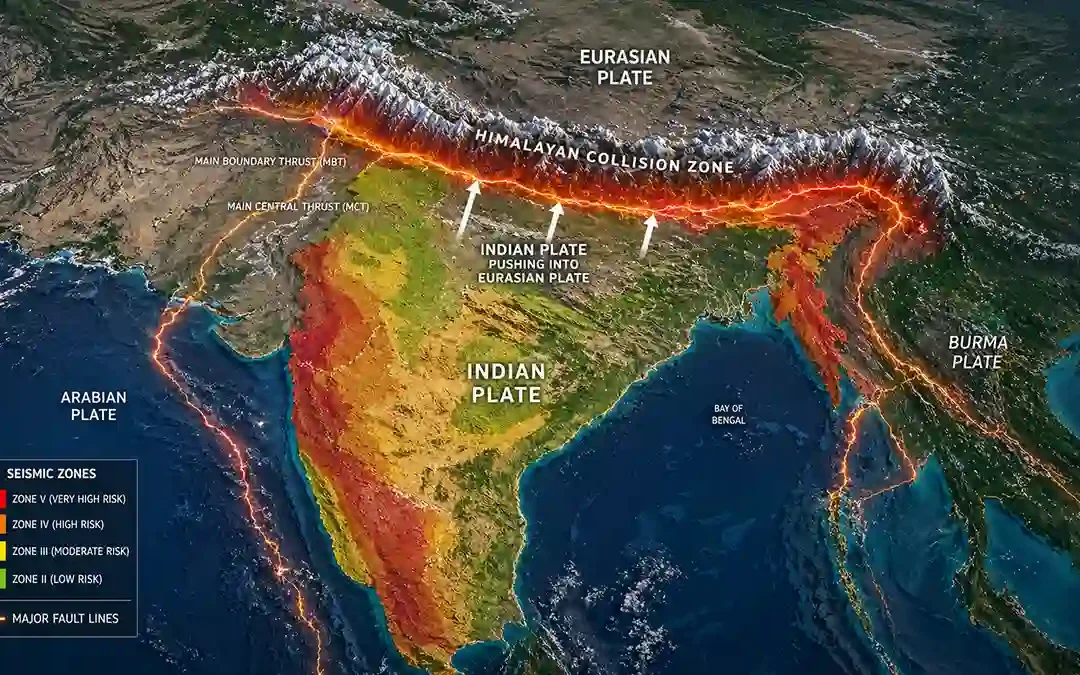
India’s earthquakes tell a story of contrast.
On one side, the Himalayas are constantly under intense tectonic pressure. On the other, large parts of the country appear stable — yet occasionally produce surprising earthquakes.
This mix makes India one of the most interesting seismic regions in the world.
If you’re new to earthquakes, begin here → what is an earthquake
India’s Seismic Zones (Not All Regions Are Equal)
| Zone | Risk Level | What’s Happening |
|---|---|---|
| Himalayan Belt | Very High | Plate collision + compression |
| Northeast India | Very High | Active tectonic interaction |
| Indo-Gangetic Plain | High | Wave amplification |
| Peninsular India | Moderate | Intraplate stress |
| Western & Central India | Low–Moderate | Stable crust with hidden faults |
India is divided into seismic zones based on risk, not uniform activity
To understand how stress builds → fault lines
What Drives Earthquakes in India?
India sits on the moving Indian Plate, which is slowly colliding with the Eurasian Plate.
Here’s the key process:
- The Indian Plate moves north
- It pushes into Eurasia
- The crust compresses and uplifts
- Stress builds along faults
- Eventually, earthquakes occur
This is the same process that formed the Himalayas — and it’s still happening today.
Learn more → causes of earthquakes
India’s Three Earthquake Behaviors (Unique Insight)
Himalayan Collision Zone (High Energy)
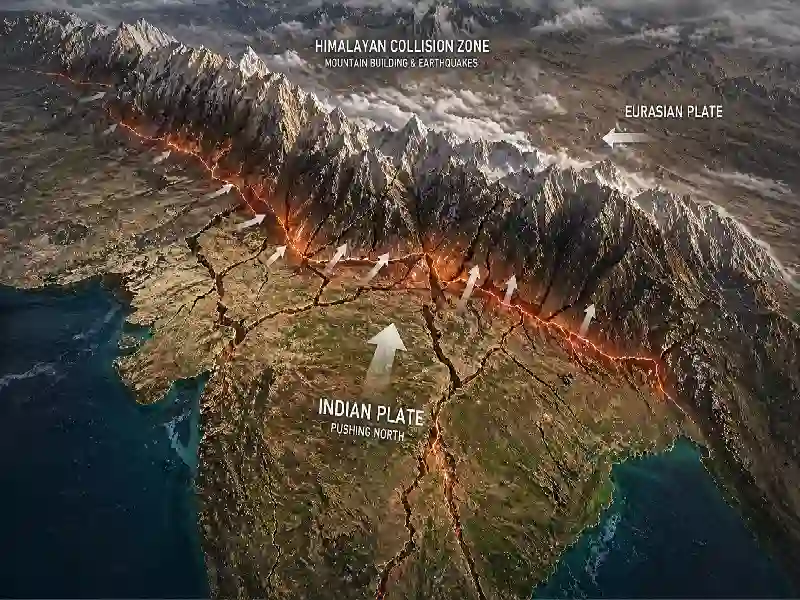
The Himalayas are India’s most active seismic region.
- Continuous plate collision
- Strong compression forces
- Potential for large earthquakes
This region stores enormous tectonic energy.
Explore earthquake types
Northeast India (Complex Tectonics)
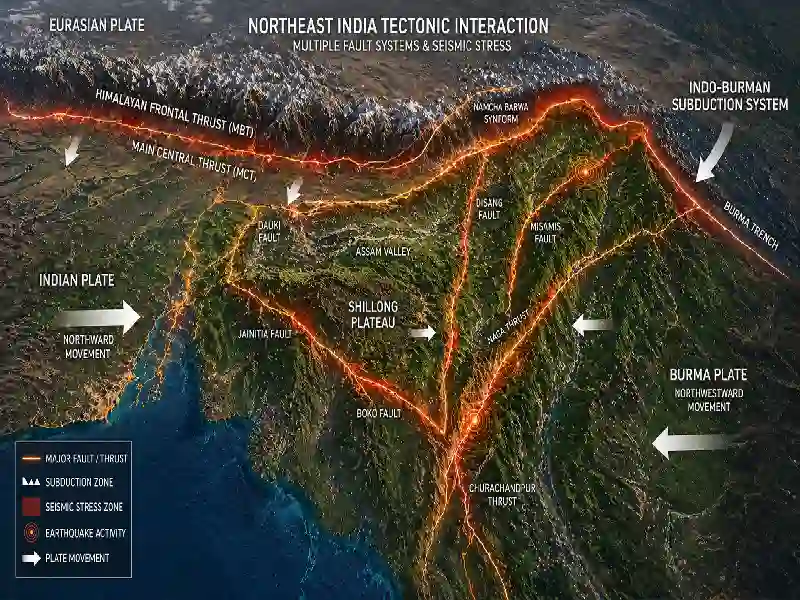
Northeast India is another highly active zone.
- Multiple plate interactions
- Frequent earthquakes
- Complex fault systems
This area is one of the most seismically active parts of the country.
Peninsular India (Unexpected Earthquakes)
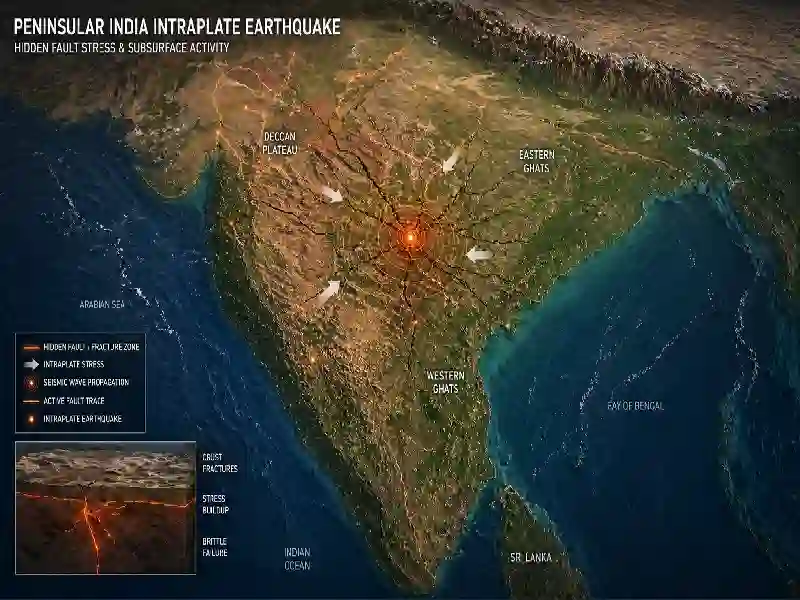
Most of India appears stable — but earthquakes still occur.
- Intraplate earthquakes
- Hidden faults
- Less frequent but sometimes surprising
This shows that earthquakes aren’t limited to plate boundaries.
Recent Earthquake Activity in India
India experiences earthquakes across different regions.
Recent patterns show:
- Frequent activity in the Himalayan belt
- Occasional earthquakes in central and southern India
- Aftershocks following larger events
This reflects ongoing tectonic pressure across the region.
Notable Earthquakes in India
Past events highlight the risks.
- 2001 Gujarat Earthquake (M7.7)
A major intraplate earthquake in western India. - 1934 Bihar–Nepal Earthquake (M8.1)
One of the largest earthquakes affecting northern India. - 1905 Kangra Earthquake (M7.8)
A devastating Himalayan earthquake.
Understand magnitude vs impact
India vs Other Earthquake Regions
India’s seismic behavior is quite unique.
- India → collision-driven + intraplate earthquakes
- Nepal → pure collision zone
- China → distributed continental stress
- California → transform faults like the San Andreas Fault
India combines boundary and interior seismic activity
Can Earthquakes in India Be Predicted?
No — earthquakes cannot be predicted precisely.
Scientists can:
- monitor seismic zones
- track fault activity
- estimate long-term risk
But exact timing remains unknown.
Learn more about can earthquakes be predicted
Because of the collision between the Indian and Eurasian plates.
Less common, but intraplate earthquakes can occur.
The Himalayan and Northeast regions.
Yes — tectonic pressure continues to build.
Final Thoughts
India’s earthquakes are shaped by both powerful collisions and hidden stresses. From the rising Himalayas to unexpected intraplate events, the country shows how complex Earth’s tectonic system can be.
Understanding this pattern helps you see that earthquakes aren’t always obvious — sometimes they build quietly over time.