
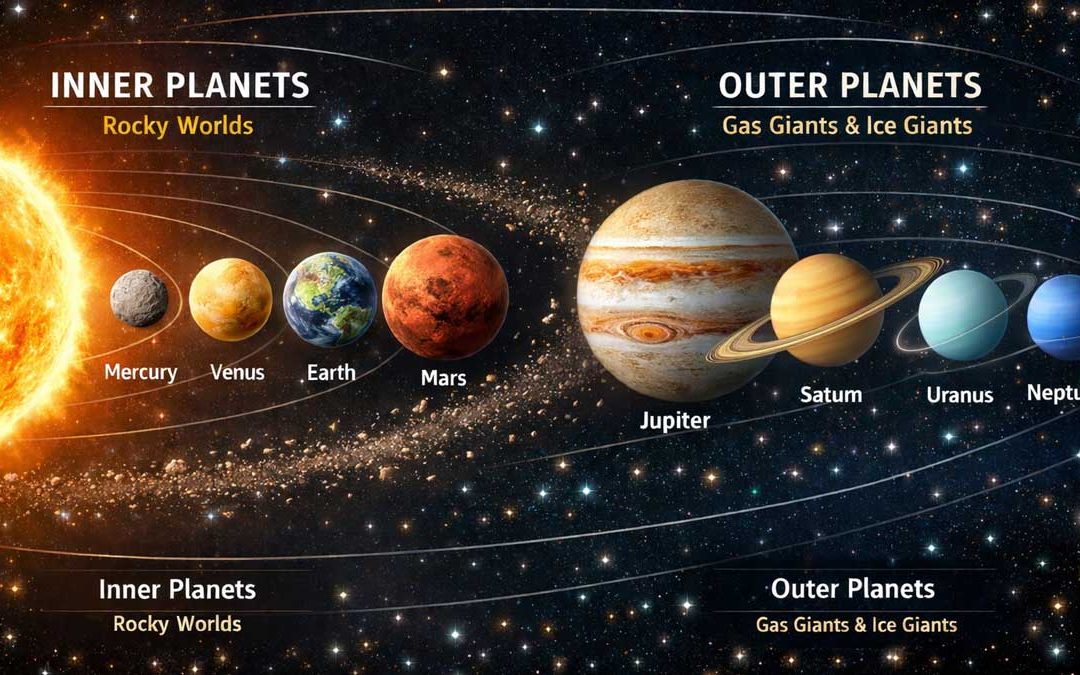
The planets in our solar system are commonly divided into two groups: inner planets and outer planets. These groups differ significantly in size, composition, atmosphere, and distance from the Sun.
The four planets closest to the Sun are called inner planets, while the four planets farther away are known as outer planets. Understanding these two groups helps scientists study how planets formed and evolved within the solar system.
What Are Inner Planets?
The inner planets are the four planets located closest to the Sun.
They include:
These planets are also known as terrestrial planets because they have rocky surfaces and solid structures.
Characteristics of Inner Planets
• Smaller in size
• Rocky composition
• Higher density
• Few or no moons
• No ring systems
Inner planets formed from rocky materials and metals during the early formation of the solar system.
What Are Outer Planets?
The outer planets are the four planets located farther from the Sun.
They include:
These planets are much larger and are composed mostly of gases and ices, which is why they are called gas giants and ice giants.
Characteristics of Outer Planets
• Much larger than inner planets
• Thick atmospheres
• Many moons
• Ring systems
• Lower density
Because they formed in colder regions of the solar system, they were able to accumulate large amounts of gas.
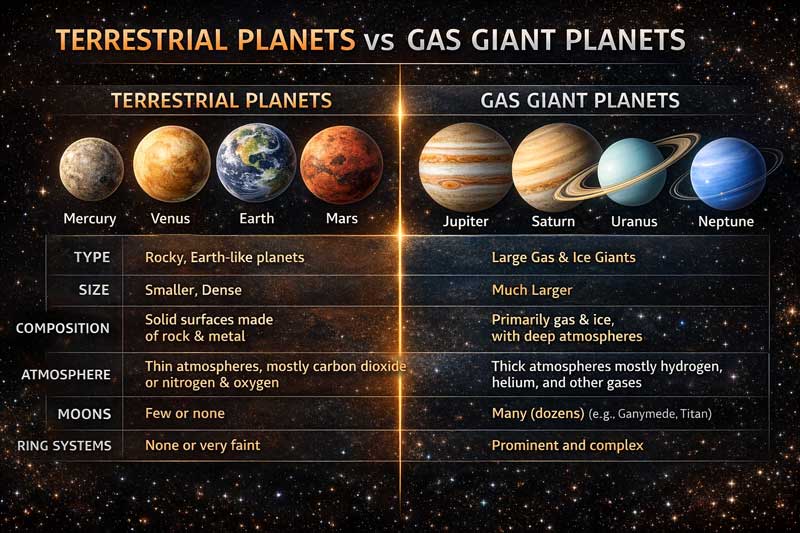
Key Differences Between Inner and Outer Planets
| Feature | Inner Planets | Outer Planets |
|---|---|---|
| Location | Close to the Sun | Far from the Sun |
| Composition | Rocky | Gas and ice |
| Size | Smaller | Much larger |
| Number of Moons | Few or none | Many moons |
| Rings | None | All have rings |
| Temperature | Warmer | Colder |
The biggest difference is that inner planets are solid rocky worlds, while outer planets are massive planets made mostly of gas and ice.
The Asteroid Belt Between Planet Groups
Between the inner and outer planets lies the asteroid belt, a region filled with thousands of rocky objects orbiting the Sun.
This belt separates:
Inner planets → Mercury, Venus, Earth, Mars
Outer planets → Jupiter, Saturn, Uranus, Neptune
Scientists believe the asteroid belt contains leftover material from the formation of the solar system.
Why Are Outer Planets Much Larger?
Outer planets formed in colder regions of the solar system where gases like hydrogen and helium were abundant.
Because of this, they were able to grow much larger by attracting large amounts of gas and ice.
For example:
- Jupiter is more than twice as massive as all other planets combined.
- Saturn has the most visible ring system in the solar system.
Interesting Facts
- Earth is the largest of the inner planets.
- Jupiter is the largest planet in the solar system.
- Uranus rotates on its side compared to other planets.
- Neptune has the fastest winds in the solar system.
FAQ
There are four inner planets: Mercury, Venus, Earth, and Mars.
There are four outer planets: Jupiter, Saturn, Uranus, and Neptune.
Because they formed in hotter regions near the Sun where only rock and metal could condense.
Conclusion
The solar system is divided into two main groups of planets: inner planets and outer planets. Inner planets are small, rocky worlds close to the Sun, while outer planets are large gas and ice giants located farther away.
Studying the differences between these planets helps scientists understand how planetary systems form and evolve throughout the universe.