
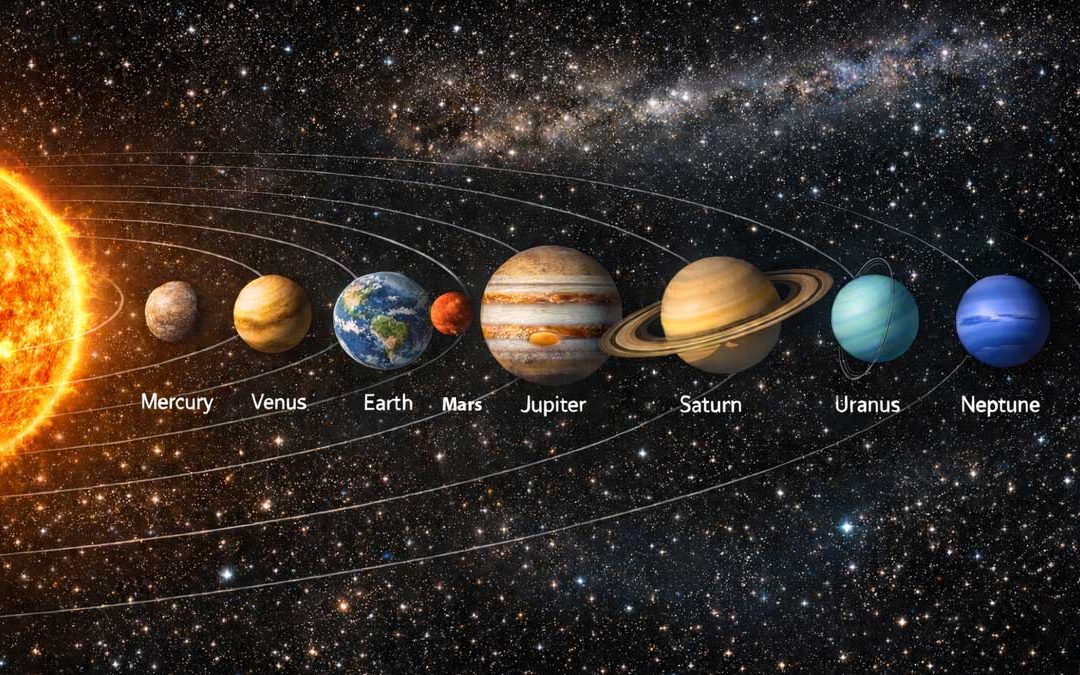
The planets in our solar system orbit the Sun at different distances. These distances influence each planet’s temperature, atmosphere, and orbital period. Scientists measure planetary distances using astronomical units (AU), where 1 AU equals the average distance between Earth and the Sun — about 149.6 million kilometers.
Understanding the distance of planets from the Sun helps astronomers study the structure of the solar system and how planets formed billions of years ago.
Order of Planets from the Sun
The eight planets are arranged in the following order based on their distance from the Sun:
The first four planets are known as inner planets, while the remaining four are outer planets.
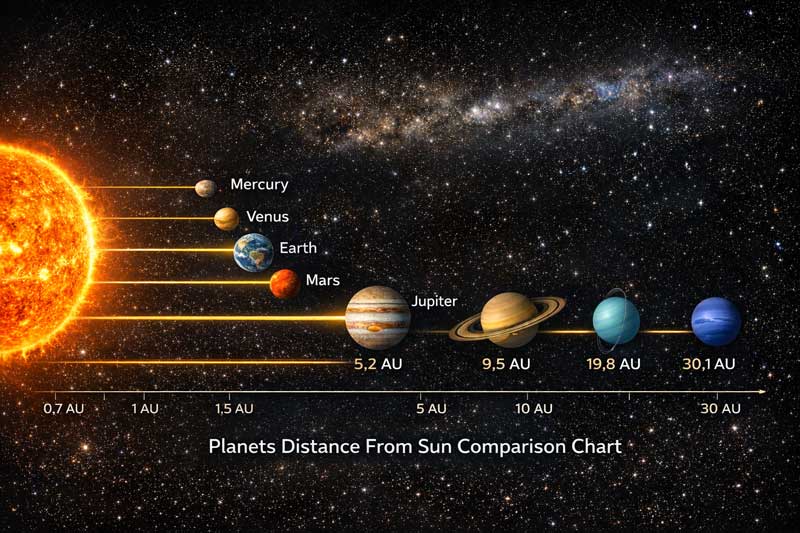
Distance of Each Planet from the Sun
| Planet | Average Distance (Million km) | Distance (AU) |
|---|---|---|
| Mercury | 57.9 | 0.39 |
| Venus | 108.2 | 0.72 |
| Earth | 149.6 | 1.00 |
| Mars | 227.9 | 1.52 |
| Jupiter | 778.5 | 5.20 |
| Saturn | 1434 | 9.58 |
| Uranus | 2871 | 19.2 |
| Neptune | 4495 | 30.1 |
The distance increases significantly as we move farther from the Sun, which is why outer planets are much colder.
Why Distance from the Sun Matters
The distance between a planet and the Sun affects many important planetary characteristics.
Temperature
Planets closer to the Sun receive more solar energy, resulting in higher temperatures.
Orbital Period
The farther a planet is from the Sun, the longer it takes to complete one orbit.
Planetary Atmosphere
Distance influences atmospheric composition and climate conditions.
For example, Mercury experiences extreme heat, while Neptune remains extremely cold due to its great distance from the Sun.
Astronomical Units Explained
Astronomers often use astronomical units (AU) instead of kilometers to measure distances in space.
1 AU represents the average distance between Earth and the Sun.
Examples:
| Planet | Distance (AU) |
|---|---|
| Mercury | 0.39 AU |
| Earth | 1 AU |
| Jupiter | 5.2 AU |
| Neptune | 30 AU |
This measurement makes it easier to compare planetary distances.
Interesting Facts About Planetary Distances
• Neptune is nearly 30 times farther from the Sun than Earth.
• Mercury completes one orbit in just 88 days.
• Neptune takes about 165 Earth years to orbit the Sun.
• The outer planets are separated by huge distances compared to the inner planets.
Related Solar System Guides
You may also want to explore these related topics:
- Solar System Planets
- Planets Size Comparison
- Inner vs Outer Planets
- Dwarf Planets
- Asteroid Belt
These articles help explain how our solar system works.
Frequently Asked Questions
Mercury is the closest planet to the Sun.
Neptune is the farthest planet in the solar system.
Because they travel much larger orbital paths and move more slowly due to weaker solar gravity.
Conclusion
The planets in our solar system orbit the Sun at widely different distances. These distances influence planetary climates, atmospheres, and orbital periods. From the scorching surface of Mercury to the icy atmosphere of Neptune, each planet offers unique insights into how planetary systems form and evolve.
Understanding the distance of planets from the Sun is an important step in learning about the structure of our solar system and the universe beyond.