
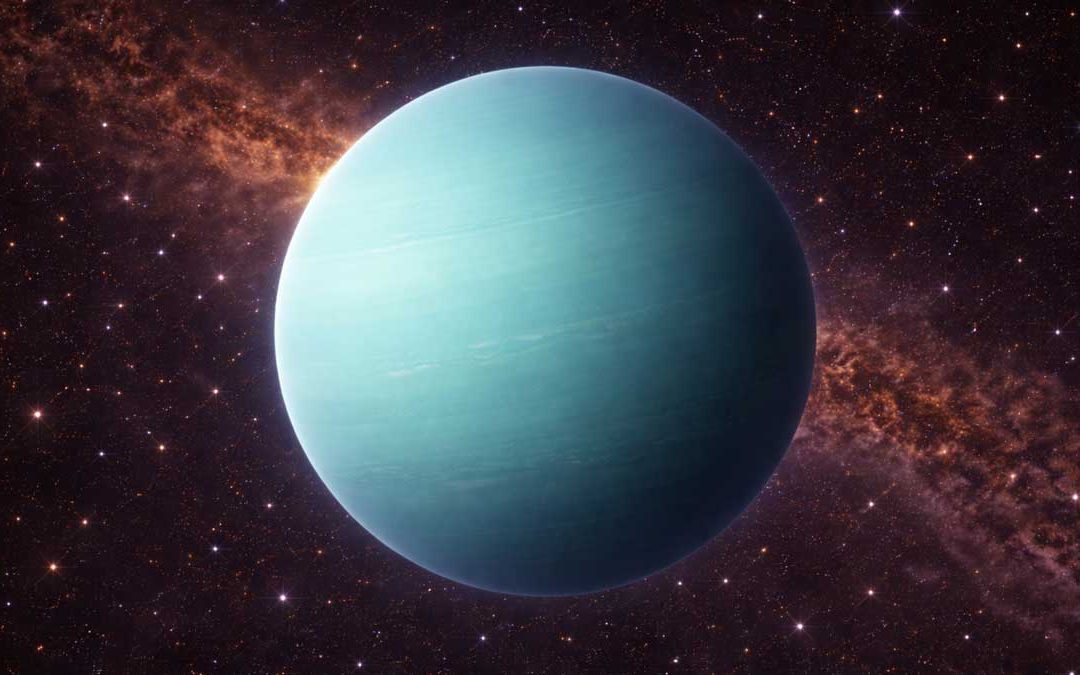
Uranus is the seventh planet from the Sun and one of the most unusual planets in the solar system. It is known for its unique sideways rotation, which makes it appear as if the planet is rolling along its orbit.
Uranus is classified as an ice giant, meaning it contains large amounts of water, methane, and ammonia ice beneath its atmosphere. The methane gas in its atmosphere gives the planet its distinctive blue-green color.
Although Uranus is extremely large, it is difficult to see from Earth without a telescope due to its great distance from the Sun.
Uranus Planet Quick Facts (7th Planet)
| Feature | Information |
|---|---|
| Planet Type | Ice Giant |
| Distance from Sun | 2.9 billion km |
| Diameter | 50,724 km |
| Length of Day | 17 hours |
| Length of Year | 84 Earth years |
| Moons | 27 known moons |
| Average Temperature | −195°C |
| Rings | 13 rings |
Size of Uranus
Uranus is the third-largest planet in the solar system by diameter.
| Planet | Diameter |
|---|---|
| Earth | 12,742 km |
| Uranus | 50,724 km |
Uranus is about four times wider than Earth.
Despite its size, Uranus is much less dense than rocky planets. Check out our eight planet size comparison.
Why Uranus Rotates on Its Side
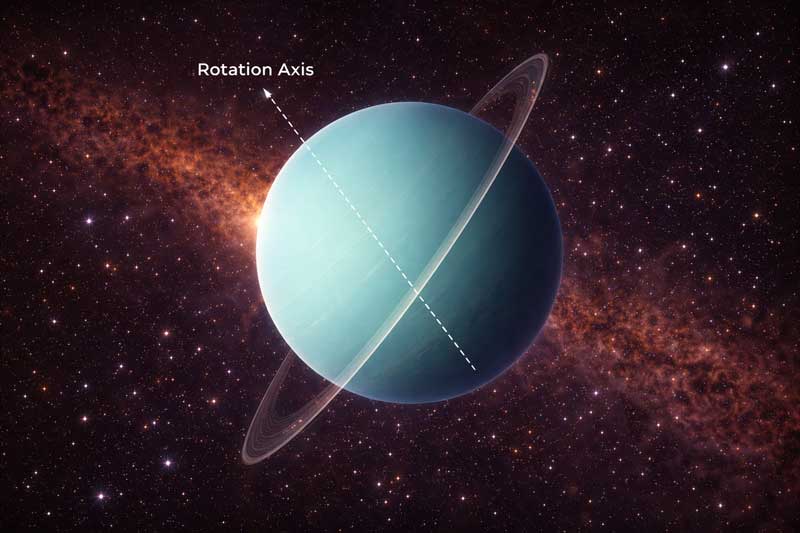
One of the most unusual features of Uranus is its extreme axial tilt.
Uranus is tilted by about 98 degrees, meaning it rotates almost completely sideways compared to other planets.
Scientists believe this tilt may have been caused by a massive collision with another large object early in the planet’s history.
Because of this tilt:
- Uranus experiences extreme seasons
- Parts of the planet can have years of continuous sunlight or darkness
Uranus Atmosphere
The atmosphere of Uranus contains:
- hydrogen
- helium
- methane
Methane absorbs red light and reflects blue light, giving Uranus its blue-green appearance.
The atmosphere also contains clouds and storms, although they are usually less visible than those on Jupiter or Saturn.
Uranus Rings
Uranus has a system of 13 known rings.
These rings are:
- darker
- thinner
- less visible than Saturn’s rings
They were discovered in 1977 when astronomers noticed stars briefly disappearing as Uranus passed in front of them.
Uranus Moons
Uranus has 27 known moons.
Most of them are named after characters from the works of William Shakespeare and Alexander Pope.
Some of the largest moons include:
| Moon | Interesting Feature |
|---|---|
| Titania | Largest moon of Uranus |
| Oberon | Second largest moon |
| Miranda | Known for unusual cliffs and canyons |
| Ariel | One of the brightest moons |
Exploration of Uranus
Only one spacecraft has visited Uranus so far.
Voyager 2
NASA’s Voyager 2 spacecraft flew past Uranus in 1986.
The mission provided the first detailed images of the planet, its rings, and its moons.
Scientists hope that future missions will explore Uranus in greater detail.
Interesting Facts About Uranus
- Uranus rotates on its side, unlike other planets.
- It takes 84 Earth years to complete one orbit around the Sun.
- Uranus has 27 moons.
- The planet appears blue-green because of methane gas.
- Uranus has a faint system of 13 rings.
Other Planets in the Solar System
Uranus is one of eight planets that orbit the Sun.
Explore the other planets:
- Mercury – the smallest planet
- Venus – the hottest planet
- Earth – the only known planet with life
- Mars – the red planet
- Jupiter – the largest planet
- Saturn – famous for its rings
- Neptune – the farthest planet
Also read the full guide: Solar System Planets
FAQ About Uranus
Uranus appears blue because methane gas in its atmosphere absorbs red light and reflects blue light.
Uranus has 27 known moons.
Scientists believe a massive collision early in its history caused the planet’s unusual tilt.
Uranus is actually the coldest planet in the solar system, despite being closer to the Sun than Neptune.