
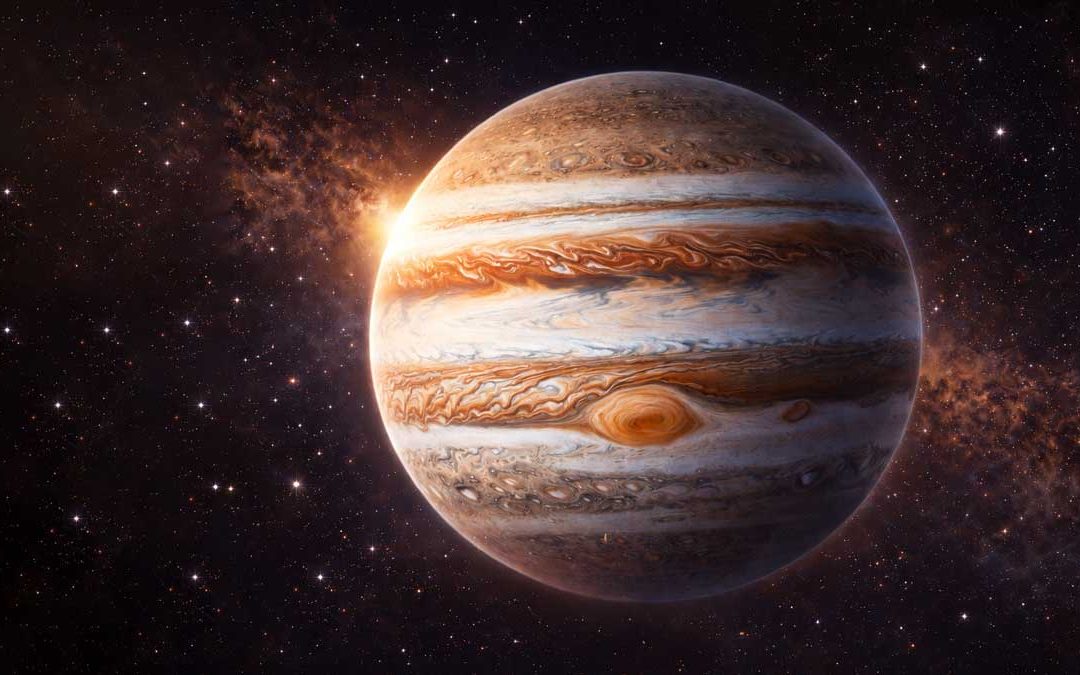
Jupiter is the largest planet in the solar system and the fifth planet from the Sun. This massive world is known as a gas giant because it is made mostly of hydrogen and helium rather than solid rock.
The planet is famous for its powerful storms, especially the Great Red Spot, a giant storm that has been raging for centuries. Jupiter also has dozens of moons and a faint ring system.
Because of its enormous size and strong gravity, Jupiter plays an important role in shaping the structure of the solar system.
Jupiter Planet Quick Facts (5th Planet)
| Feature | Information |
|---|---|
| Planet Type | Gas Giant |
| Distance from Sun | 778 million km |
| Diameter | 139,820 km |
| Length of Day | 10 hours |
| Length of Year | 11.86 Earth years |
| Moons | 95+ known moons |
| Average Temperature | −145°C |
| Rings | Yes (faint dust rings) |
Size of Jupiter
Jupiter is enormous compared to the other planets.
| Planet | Diameter |
|---|---|
| Earth | 12,742 km |
| Jupiter | 139,820 km |
Jupiter is more than 11 times wider than Earth.
In fact, over 1,300 Earth-sized planets could fit inside Jupiter.
Despite its huge size, Jupiter is mostly made of gas, so it does not have a solid surface like Earth. Check out the planet size comparison.
Jupiter’s Atmosphere
Jupiter’s atmosphere is made mainly of:
- hydrogen
- helium
- ammonia
- methane
The planet has colorful cloud bands that move at extremely high speeds.
These clouds create powerful storms and strong winds across the planet’s atmosphere.
The Great Red Spot
One of Jupiter’s most famous features is the Great Red Spot.
This is a gigantic storm that has been observed for more than 300 years.
Key facts about the storm:
| Feature | Detail |
|---|---|
| Storm Type | Giant hurricane-like storm |
| Size | Larger than Earth |
| Age | At least 300 years |
Scientists continue to study this storm to understand how it has lasted so long.
Jupiter’s Moons
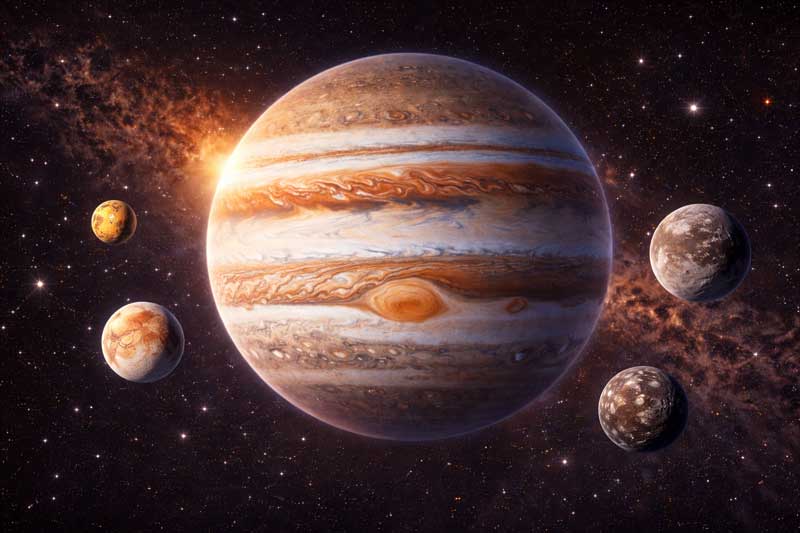
Jupiter has more moons than any other planet.
Currently, astronomers have discovered over 95 moons orbiting Jupiter.
The four largest moons are known as the Galilean moons, discovered by Galileo Galilei in 1610.
| Moon | Interesting Feature |
|---|---|
| Io | Most volcanically active body in the solar system |
| Europa | May contain an underground ocean |
| Ganymede | Largest moon in the solar system |
| Callisto | Covered with ancient impact craters |
These moons are some of the most interesting worlds in the solar system.
Jupiter’s Rings
Although Saturn is famous for its rings, Jupiter also has a ring system.
Jupiter’s rings are much fainter and made mostly of dust particles.
They were first discovered by the Voyager spacecraft in 1979.
Jupiter’s Gravity and Influence
Jupiter’s gravity is extremely powerful.
It plays an important role in protecting the inner planets by attracting or deflecting asteroids and comets.
Because of this, some scientists refer to Jupiter as a cosmic shield for the inner solar system.
Exploration of Jupiter
Several spacecraft have studied Jupiter.
Pioneer Missions
NASA’s Pioneer 10 and Pioneer 11 were the first spacecraft to fly past Jupiter in the 1970s.
Voyager Missions
Voyager spacecraft captured detailed images of Jupiter and its moons.
Juno Mission
NASA’s Juno spacecraft, launched in 2011, is currently orbiting Jupiter and studying its atmosphere, gravity, and magnetic field.
Interesting Facts About Jupiter
• Jupiter is the largest planet in the solar system.
• It has the shortest day of any planet, lasting about 10 hours.
• Jupiter’s storm, the Great Red Spot, has lasted for centuries.
• The planet has over 95 moons.
• Jupiter’s magnetic field is the strongest of any planet.
Other Planets in the Solar System
Jupiter is only one of the eight planets orbiting the Sun.
Explore the others:
- Mercury – the smallest planet
- Venus – the hottest planet
- Earth – the only known planet with life
- Mars – the red planet
- Saturn – famous for its rings
- Uranus – the tilted ice giant
- Neptune – the farthest planet
Also read the full guide: Solar System Planets
FAQ About Jupiter
Jupiter formed early in the solar system and gathered a huge amount of gas from the surrounding nebula.
No. Jupiter is a gas giant made mostly of hydrogen and helium.
Astronomers have discovered more than 95 moons orbiting Jupiter.
No. Jupiter has no solid surface, and the pressure deep in its atmosphere would be extremely dangerous.