
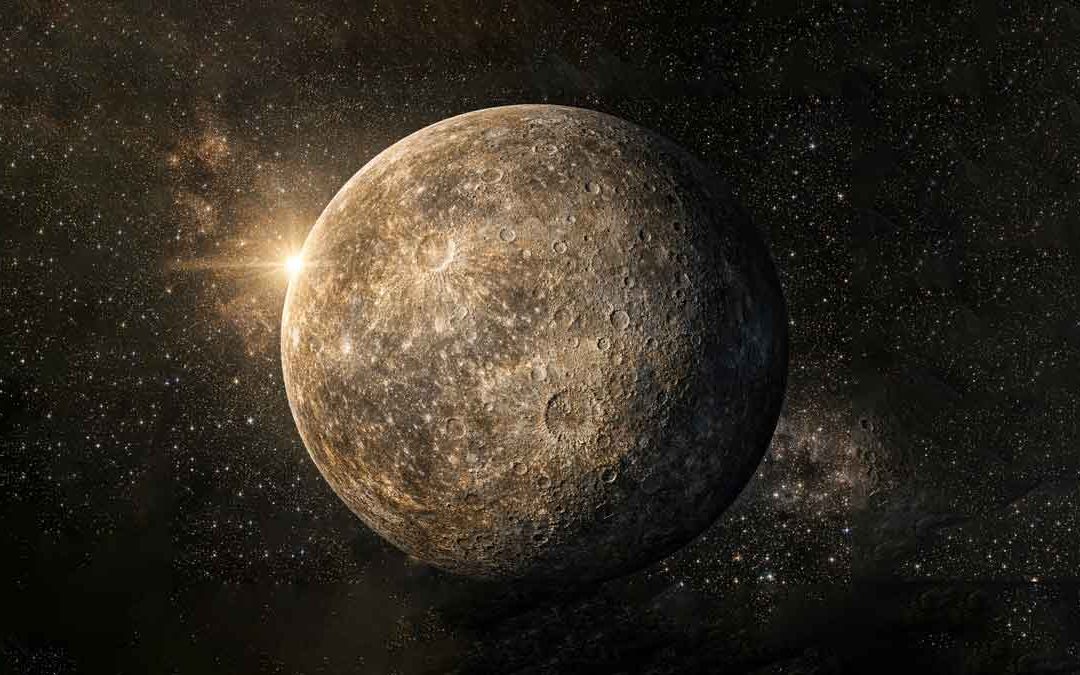
Mercury is the closest planet to the Sun and the smallest planet in the solar system. Despite being so near to the Sun, Mercury is not the hottest planet — that title actually belongs to Venus.
Because Mercury is small and lacks a thick atmosphere, it experiences extreme temperature changes between day and night. The planet also moves incredibly fast around the Sun, completing one orbit in just 88 Earth days.
Mercury has fascinated astronomers for centuries and continues to be studied by spacecraft and telescopes to better understand how rocky planets form and evolve.
Mercury Planet Quick Facts (1st Planet from the Sun)
| Feature | Information |
|---|---|
| Planet Type | Rocky (Terrestrial) |
| Distance from Sun | 57.9 million km |
| Diameter | 4,880 km |
| Length of Day | 59 Earth days |
| Length of Year | 88 Earth days |
| Moons | 0 |
| Average Temperature | 167°C (332°F) |
| Surface Gravity | 38% of Earth |
Size of Mercury
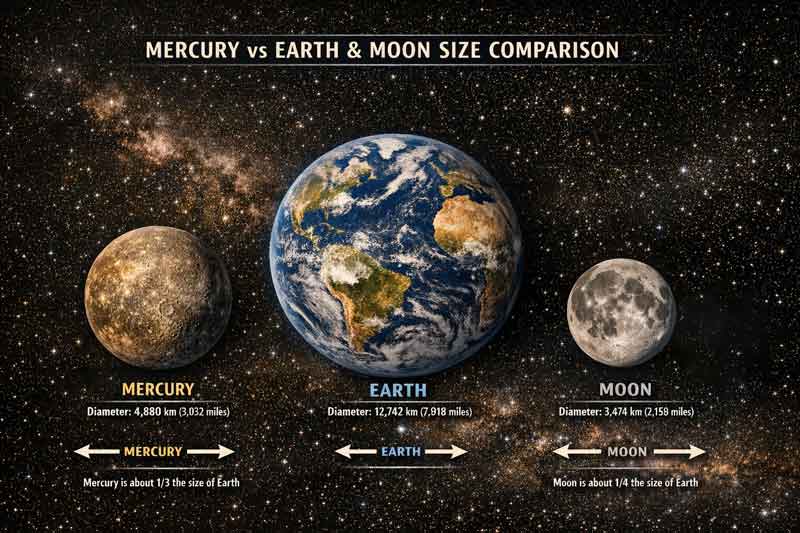
Mercury has a diameter of about 4,880 kilometers (3,032 miles).
To understand how small it is:
- Mercury is smaller than Earth
- It is only slightly larger than Earth’s Moon
- It is the smallest of the eight planets
However, despite its small size, Mercury is still massive enough for gravity to shape it into a nearly perfect sphere.
learn more about: Planets Size Comparison
Mercury’s Surface
The surface of Mercury looks very similar to Earth’s Moon.
It is covered with:
- impact craters
- rocky plains
- cliffs called scarps
These craters formed when asteroids and meteoroids struck the planet billions of years ago.
One of the most famous craters on Mercury is the Caloris Basin, which is about 1,550 kilometers wide.
Mercury’s Temperature
Mercury experiences some of the most extreme temperatures in the solar system.
| Time | Temperature |
|---|---|
| Daytime | Up to 427°C (800°F) |
| Nighttime | Down to −179°C (−290°F) |
This huge difference happens because Mercury has almost no atmosphere to trap heat.
Mercury’s Orbit and Rotation
Mercury moves around the Sun faster than any other planet.
- One Mercury year = 88 Earth days
- One Mercury day = 59 Earth days
Interestingly, a single day on Mercury is longer than its year.
Does Mercury Have Moons?
Mercury has no moons.
Only two planets in the solar system have no natural satellites:
- Mercury
- Venus
Scientists believe Mercury’s small size and strong gravitational influence from the Sun may have prevented it from capturing moons.
Mercury’s Atmosphere
Mercury does not have a traditional atmosphere.
Instead, it has a very thin layer called an exosphere, made of atoms blasted from the surface by solar wind.
This exosphere contains elements like:
- oxygen
- sodium
- hydrogen
- helium
- potassium
Because it is extremely thin, it cannot protect the planet from meteoroids or radiation.
Exploration of Mercury
Several space missions have studied Mercury.
Mariner 10
Launched in 1973, it was the first spacecraft to visit Mercury.
MESSENGER
NASA’s MESSENGER mission orbited Mercury between 2011 and 2015 and provided detailed images of the planet.
BepiColombo
A joint mission by ESA and JAXA, launched in 2018, is currently traveling to Mercury to study the planet in greater detail.
Interesting Facts About Mercury
- Mercury is the fastest planet in the solar system.
- A year on Mercury lasts only 88 Earth days.
- Mercury has huge cliffs formed as the planet shrank while cooling.
- Temperatures vary by more than 600°C between day and night.
- Mercury has been known since ancient times because it is visible to the naked eye.
Why Scientists Study Mercury
Studying Mercury helps scientists understand the formation of rocky planets.
Because it formed close to the Sun, Mercury provides clues about the early conditions of the solar system and how planetary surfaces change over billions of years.
Understanding Mercury also helps scientists compare it with planets around other stars.
Learn More About the Solar System
Mercury is only one part of our solar system. To understand the full picture, explore the other planets and how they differ from one another.
- Venus – the hottest planet
- Earth – the only known planet with life
- Mars – the red planet
- Jupiter – the largest planet
- Saturn – famous for its rings
- Uranus – the tilted ice giant
- Neptune – the farthest planet
Read the complete guide here: Solar System Planets
No. Venus is actually hotter because its thick atmosphere traps heat.
A year on Mercury lasts 88 Earth days.
Mercury’s small size and the Sun’s strong gravity likely prevented it from capturing moons.
No. Extreme temperatures and lack of atmosphere make Mercury unsuitable for life.