
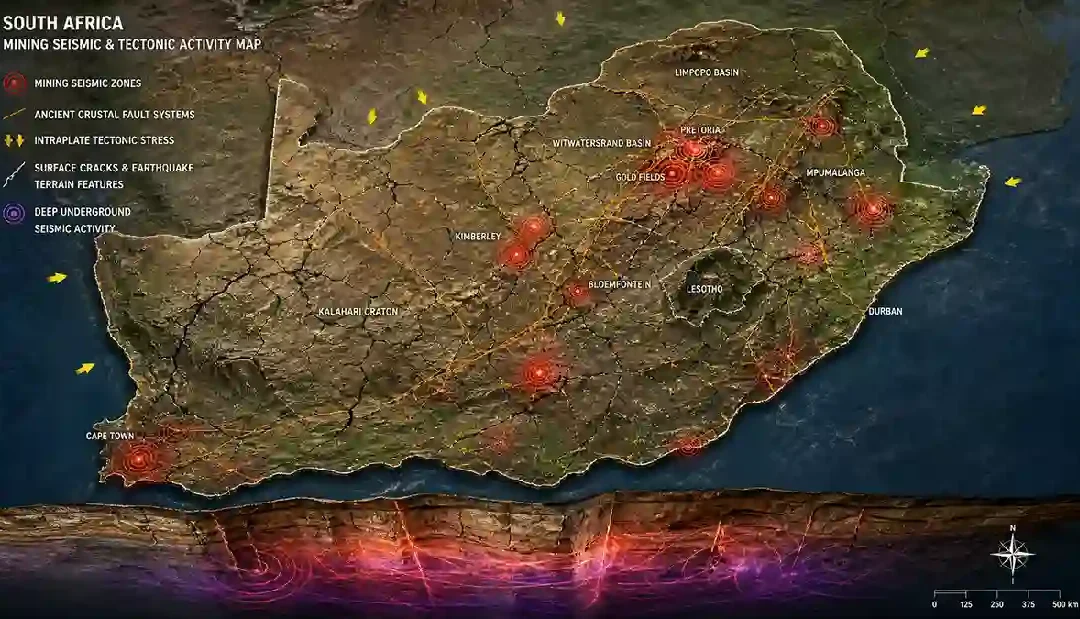
South Africa is far from the world’s major tectonic plate boundaries. So many people are surprised to learn that earthquakes still happen here. But South Africa’s earthquakes are unusual. Some are natural earthquakes linked to ancient crustal stress, while others are connected to one of the country’s biggest industries: deep underground mining.
That makes South Africa one of the most unique seismic regions in the world.
If you’re new to earthquakes, begin here → what is an earthquake
South Africa’s Main Seismic Regions
| Region | Risk Level | Main Cause |
|---|---|---|
| Mining Regions (Gauteng & Free State) | High | Mining-induced seismicity |
| Western Cape | Moderate | Ancient fault activity |
| KwaZulu-Natal | Low–Moderate | Crustal stress |
| Northern South Africa | Low | Stable crust |
| Offshore Southern Coast | Moderate | Offshore tectonic movement |
Many South African earthquakes happen deep underground near mining operations.
To understand how tectonic stress builds → fault lines
Why Do Earthquakes Happen in South Africa?
South Africa’s earthquakes come from two main sources:
1. Natural Crustal Stress
Ancient faults beneath the African continent still store tectonic stress.
2. Mining-Induced Earthquakes
Deep mining changes underground pressure.
When rock layers suddenly shift, earthquakes can occur.
This type of seismic activity is called induced seismicity.
Learn more → causes of earthquakes
South Africa’s Four Distinct Earthquake Systems
Mining-Induced Earthquakes (South Africa’s Most Unique Feature)
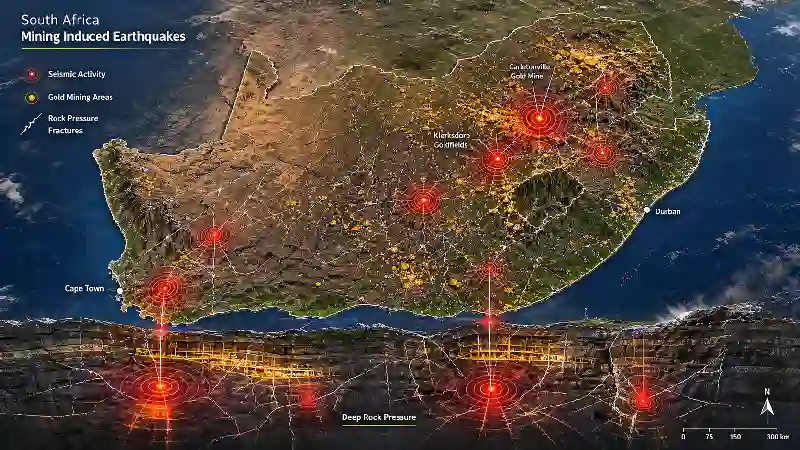
South Africa is famous for deep gold mining.
- Underground excavation changes rock pressure
- Stress builds near mining tunnels
- Sudden rock movement creates earthquakes
Some mining earthquakes are strong enough to damage infrastructure.
Explore earthquake types
Ancient Crustal Fault Activity
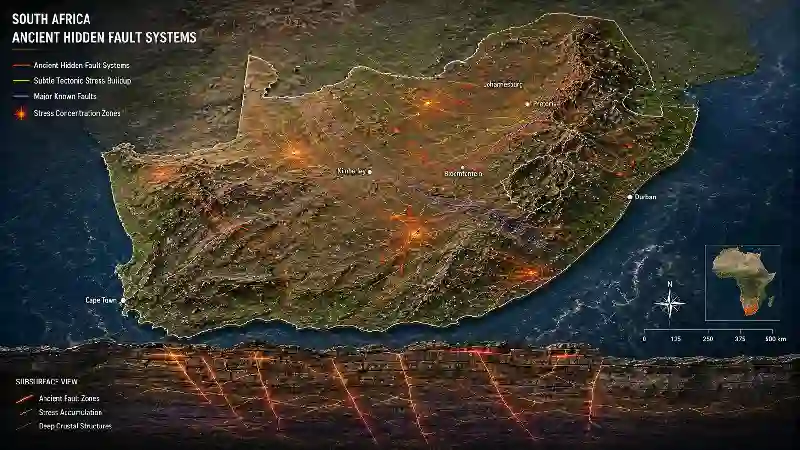
South Africa sits on very old continental crust.
- Ancient faults still exist underground
- Weak tectonic stress continues today
- Natural earthquakes still occur occasionally
Offshore Southern Coast Seismic Zones
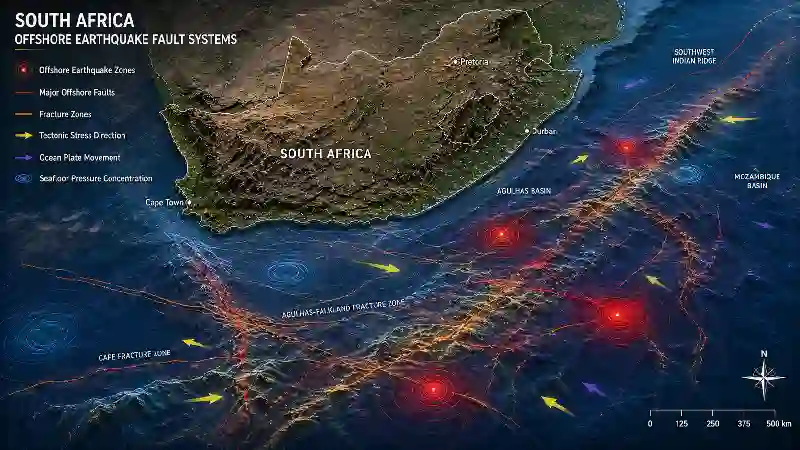
Some earthquakes occur offshore near the southern coast.
- Offshore fault movement
- Mild tectonic adjustment
- Occasional measurable earthquakes
Stable Interior Regions
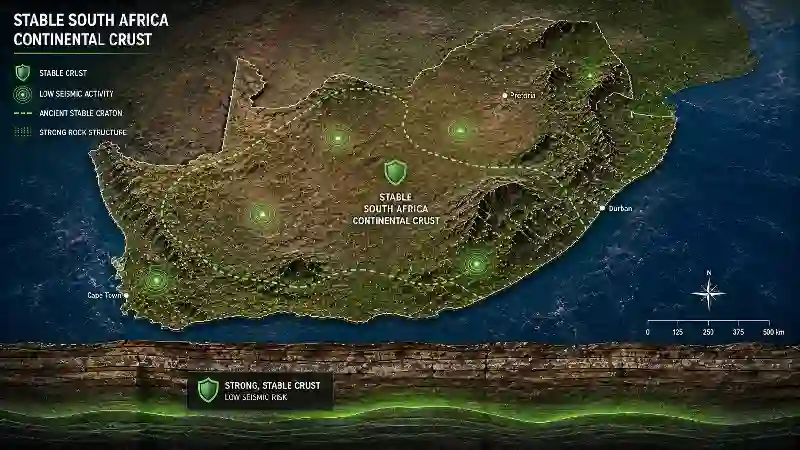
Large parts of South Africa remain relatively stable.
- Very low tectonic stress
- Few natural earthquakes
- Most seismic activity concentrated elsewhere
Recent Earthquake Activity in South Africa
South Africa experiences small earthquakes regularly.
Recent patterns show:
- Mining-related tremors near deep mining areas
- Small natural earthquakes in western regions
- Occasional offshore seismic activity
Most earthquakes are minor, but stronger events can still occur.
Notable Earthquakes in South Africa
South Africa has experienced several important earthquakes.
- 1969 Tulbagh Earthquake (M6.3)
One of South Africa’s strongest recorded earthquakes. - 2014 Orkney Earthquake (M5.5)
Linked partly to deep mining activity. - Mining Tremors in Gauteng & Free State
Frequent small seismic events continue today.
Understand magnitude vs impact
South Africa vs Other Earthquake Regions
South Africa’s earthquakes are very different from major plate-boundary regions.
- South Africa → mining-induced + intraplate earthquakes
- Morocco → Mediterranean tectonic compression
- Iceland → volcanic + tectonic spreading
- California → transform faults like the San Andreas Fault
South Africa is one of the world’s best examples of human-influenced seismic activity.
Can Earthquakes in South Africa Be Predicted?
No — earthquakes cannot be predicted precisely.
Scientists can:
- monitor seismic activity
- track mining-related stress changes
- map ancient faults
But exact timing remains uncertain.
Learn more → Can earthquakes be predicted
Because of ancient crustal stress and deep mining activity.
Some are natural, while others are linked to mining.
Mining regions in Gauteng and Free State.
Yes — although rare, damaging earthquakes can still occur.
Final Thoughts
South Africa’s earthquakes reveal that seismic activity does not only happen near tectonic plate boundaries. Ancient faults, underground stress, and deep mining operations all contribute to the country’s unique seismic behavior.
That makes South Africa one of the most scientifically interesting earthquake regions in Africa.