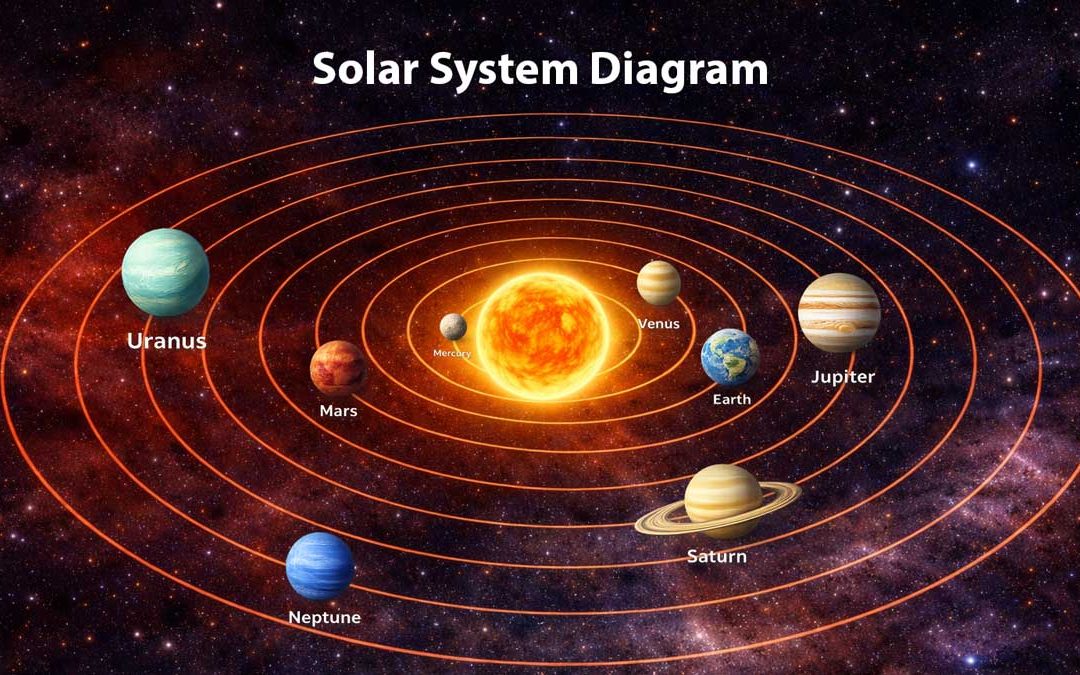
A solar system diagram helps us understand how planets are arranged around the Sun. It shows the order of planets, their orbits, and their relative positions in space.
The solar system consists of the Sun and everything that revolves around it, including eight planets, dwarf planets, moons, asteroids, and comets.
In this guide, you will learn how to read a solar system diagram and understand the structure of our cosmic neighborhood.
Solar System Diagram with Planets in Order
The planets in our solar system follow a specific order based on their distance from the Sun.
Correct Order of Planets
This order is always shown in a standard solar system diagram.
Inner and Outer Planets in the Diagram
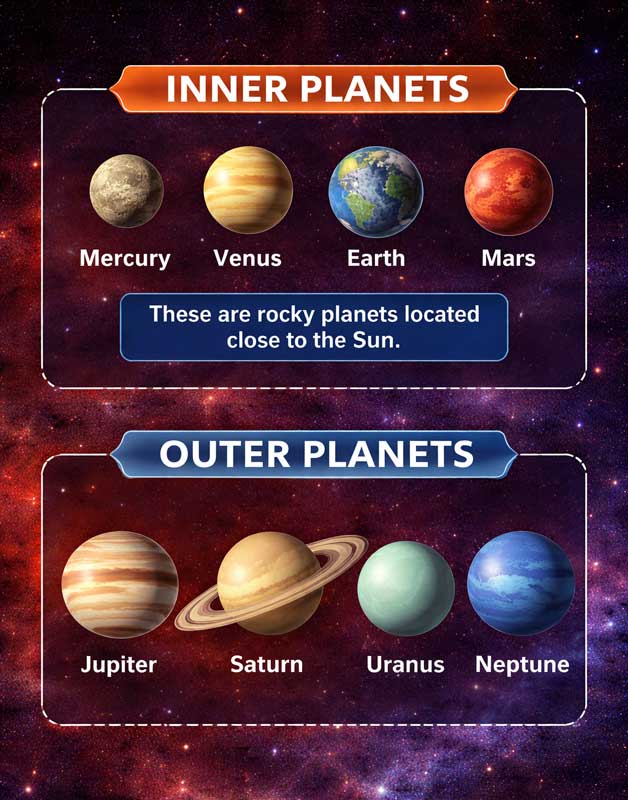
A solar system is usually divided into two main parts:
Inner Planets
- Mercury
- Venus
- Earth
- Mars
These are rocky planets located close to the Sun.
Outer Planets
- Jupiter
- Saturn
- Uranus
- Neptune
These are much larger and mostly made of gas and ice.
Asteroid Belt in the Solar System
Between Mars and Jupiter lies the asteroid belt.
It is an important feature often shown in diagrams because it separates:
Inner planets → Mercury to Mars
Outer planets → Jupiter to Neptune
The asteroid belt contains millions of rocky objects orbiting the Sun.
Planet Distances from the Sun
Solar system diagrams often include distances to show how far each planet is from the Sun.
| Planet | Distance from Sun (Approx) |
|---|---|
| Mercury | 58 million km |
| Venus | 108 million km |
| Earth | 150 million km |
| Mars | 228 million km |
| Jupiter | 778 million km |
| Saturn | 1.4 billion km |
| Uranus | 2.9 billion km |
| Neptune | 4.5 billion km |
Why Solar System Diagrams Are Not to Scale
Most diagrams are not perfectly to scale.
Reasons:
- distances are extremely large
- planets would appear too small
- space between planets is huge
So diagrams are simplified to make them easier to understand.
Why Solar System Diagrams Are Important
- understand planet order
- visualize distances
- learn about planetary groups
- support education and research
They are widely used in schools, textbooks, and scientific studies.
FAQ
A solar system diagram is a visual representation showing the Sun and planets in order.
Eight planets are shown in a standard solar system diagram.
Because real distances and sizes are too large to display on a single image.
Conclusion
A solar system diagram provides a simple and clear way to understand how planets orbit the Sun. It shows their order, distances, and structure, helping both beginners and advanced learners explore our solar system more effectively.