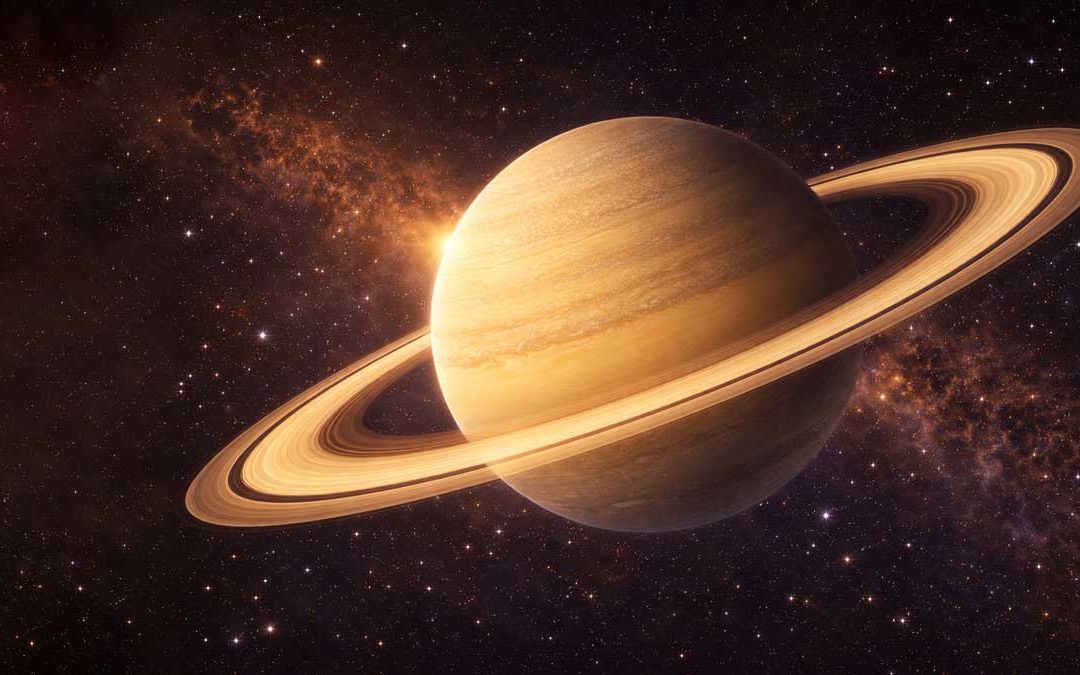
Saturn is the sixth planet from the Sun and the second-largest planet in the solar system. It is best known for its spectacular system of rings, which makes Saturn one of the most visually striking planets.
Like Jupiter, Saturn is a gas giant made mostly of hydrogen and helium. Despite its enormous size, Saturn is the least dense planet in the solar system.
Saturn has fascinated astronomers for centuries and continues to be studied by modern spacecraft.
Saturn Planet Quick Facts (6th Planet)
| Feature | Information |
|---|---|
| Planet Type | Gas Giant |
| Distance from Sun | 1.4 billion km |
| Diameter | 116,460 km |
| Length of Day | 10.7 hours |
| Length of Year | 29.5 Earth years |
| Moons | 140+ known moons |
| Average Temperature | −178°C |
| Rings | Large and visible |
Size of Saturn
Saturn is the second-largest planet in the solar system.
| Planet | Diameter |
|---|---|
| Earth | 12,742 km |
| Saturn | 116,460 km |
Saturn is about 9 times wider than Earth.
Despite its huge size, Saturn is made mostly of gas, meaning it does not have a solid surface like Earth or Mars. See all planet size comparisons.
Saturn’s Famous Rings
Saturn is most famous for its beautiful ring system.
The rings are made of:
- ice particles
- rock fragments
- dust
These particles range in size from tiny grains to objects as large as mountains.
Scientists believe the rings formed from pieces of comets, asteroids, or shattered moons that were pulled apart by Saturn’s gravity.
Saturn’s Atmosphere
Saturn’s atmosphere is mainly composed of:
- hydrogen
- helium
- methane
- ammonia
The planet has powerful winds that can reach speeds of 1,800 kilometers per hour.
Large storms sometimes appear in the atmosphere, similar to the storms seen on Jupiter.
Saturn’s Moons
Saturn has more moons than any other planet currently known.
Astronomers have discovered over 140 moons orbiting Saturn.
Some of the most interesting moons include:
| Moon | Interesting Feature |
|---|---|
| Titan | Larger than the planet Mercury |
| Enceladus | Has geysers of water ice |
| Rhea | Second largest moon of Saturn |
| Iapetus | Known for its unusual two-tone surface |
Titan
Titan is Saturn’s largest moon and one of the most fascinating objects in the solar system. It has a thick atmosphere and lakes of liquid methane and ethane.
Scientists believe Titan may provide clues about how life could develop on other worlds.
Saturn’s Density
Saturn is the least dense planet in the solar system.
In theory, if there were an ocean large enough, Saturn could float in water.
This happens because Saturn is made mostly of lightweight gases rather than heavy rock or metal.
Exploration of Saturn
Several missions have explored Saturn.
Pioneer and Voyager Missions
NASA’s Pioneer 11 and Voyager spacecraft flew past Saturn in the late 20th century.
Cassini Mission
The Cassini spacecraft, launched by NASA and ESA, studied Saturn from 2004 to 2017.
Cassini provided detailed images of Saturn’s rings, atmosphere, and moons.
The mission ended when Cassini intentionally entered Saturn’s atmosphere and burned up.
Interesting Facts About Saturn
- Saturn is famous for its massive ring system.
- It is the second-largest planet in the solar system.
- Saturn has over 140 moons.
- Winds on Saturn can reach 1,800 km/h.
- Saturn is the least dense planet in the solar system.
Other Planets in the Solar System
Saturn is just one of the eight planets that orbit the Sun.
Explore the others:
- Mercury – the smallest planet
- Venus – the hottest planet
- Earth – the only known planet with life
- Mars – the red planet
- Jupiter – the largest planet
- Uranus – the tilted ice giant
- Neptune – the farthest planet
Also read the full guide: Solar System Planets
FAQ About Saturn
Saturn’s rings are made of ice and rock particles that likely formed from broken moons or captured objects.
Astronomers have discovered more than 140 moons around Saturn.
Yes. Saturn is a gas giant, composed mainly of hydrogen and helium.
No. Saturn does not have a solid surface, so landing there would not be possible.