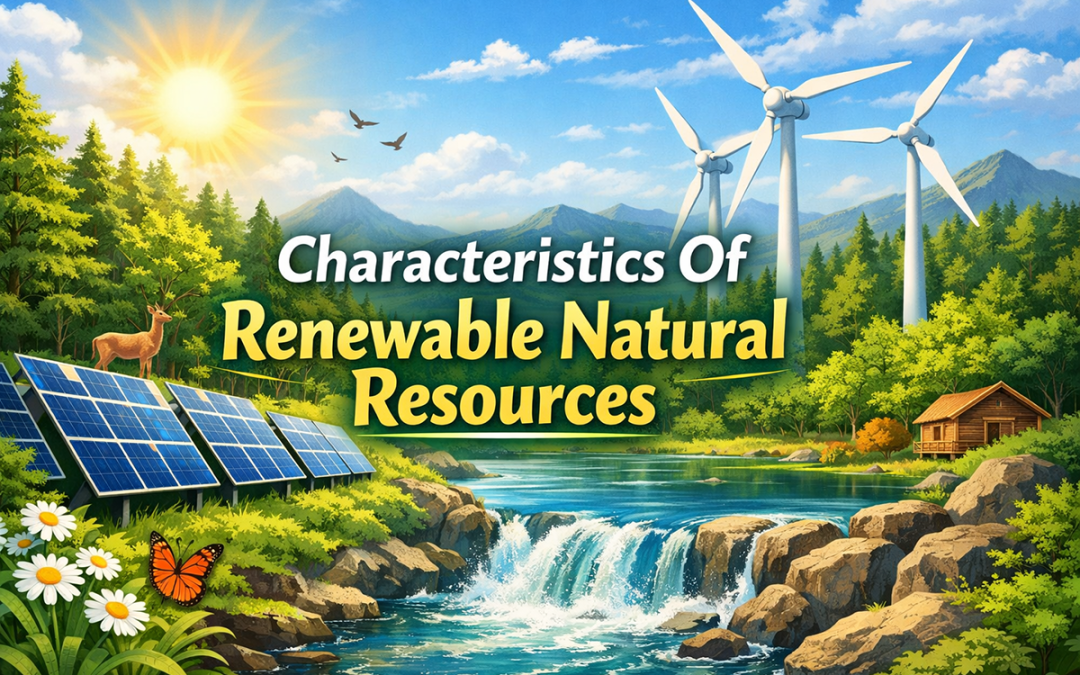
Renewable natural resources play a vital role in sustaining life and supporting economic development. Understanding their key characteristics helps in managing them wisely and ensuring their availability for future generations.
Characteristics Of Renewable Natural Resources:
The following points detail the main characteristics of renewable natural resources.
(i) Regeneration:
Renewable natural resources have the ability to regenerate, hence are inexhaustible in a physical sense. They are self-regenerating and hence have perpetual production potentials. The economic importance of this is that the consumption of one unit does not reduce future inventory by the same amount. Although renewable, all biological resources are potentially destructible, especially by their misuse and overexploitation, leading to depletion and perhaps extinction.
(ii) Multiplicity of species interaction and dependence:
The diversity and complexity of species are important properties of biological resources. These make their management difficult due to variations in the quality and uses of different species.
(iii) Naturally determined growth rate:
The rate of growth and accretion of the stock of biological resources is naturally determined by pre-determined biological processes. However, man can and has been influencing this limited growth through research. Because growth is naturally determined, time is a major decision variable in the management of biological resources. This requires a minimum waiting period for the production of any desired product, with, of course, implications for cost and return.
(iv.) Possibility of Man-made Improvement:
Technological advancement consequent upon research leads to genetic improvement and hence high yield and thus reduction in management cost. This is often achieved by deemphasizing the complexity of species composition in favor of a few selected dominant species.
(v) Biological Resources as Ecosystem:
Biological resources exist in and constitute an ecosystem of flora and fauna. These conform to important elemental concepts or principles of ecosystems, such as selection, food chain, in which the organisms consume and are consumed by others in a particular order or hierarchy. The ecosystem develops towards a climax or a state of equilibrium when mortality balances with regeneration. However, an ecosystem tends to be in a dynamic rather than static state because the nature/situation is not constant all the time.
(vi) Common Property Effect:
The principle of common property requires that the title to all environmental resources should rest collectively, and that the private use of these resources should be on the basis of a usufructural right only. Everyone claims the right to their ownership. This leads to over-exploitation as it is generally believed that if one person does not exploit the resource, someone else will do. This is contrary to their maintenance, as they are everybody’s property and hence no one can be held responsible. The consequences of these actions are over-exploitation and neglect.
Conclusion:
The characteristics of renewable natural resources highlight their regenerative nature, ecological complexity, and the challenges involved in their management. Proper understanding and responsible utilization of these resources are essential to prevent over-exploitation and to maintain ecological balance for sustainable development.