
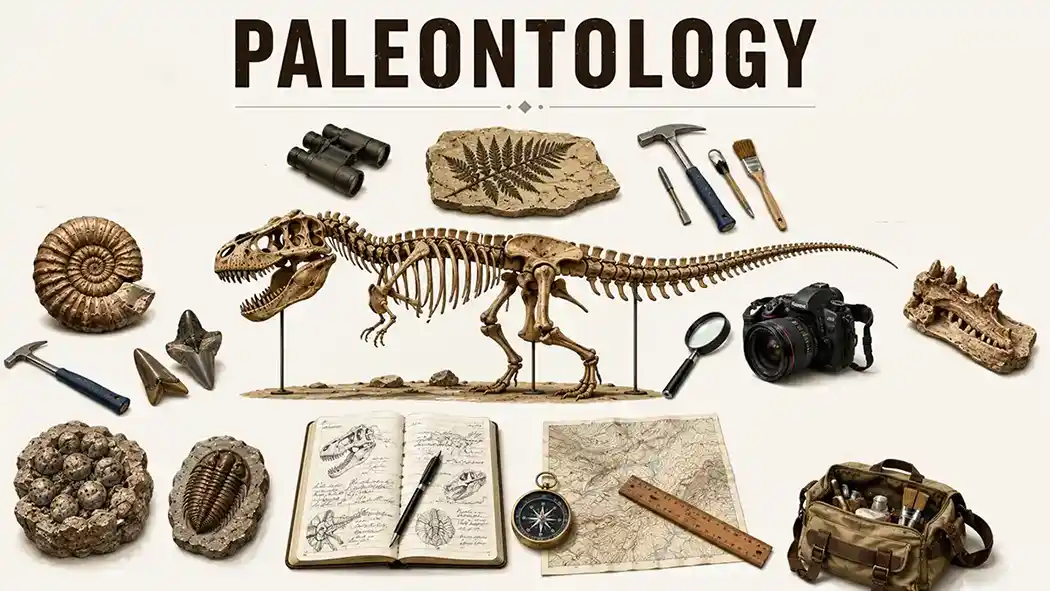
Paleontology is the scientific study of fossils, more broadly, the study of prehistoric organisms. In fact, professional conferences and publications often fall into these categories. This post gives an idea of what paleontology is and why it is essential to understanding life's journey on Earth.
What Is Paleontology?
Paleontology is the scientific study of ancient life on Earth through fossils. It helps scientists understand how organisms evolved, how ecosystems changed over millions of years, and how life has responded to past environmental and climatic changes. By examining fossils preserved in rocks, paleontologists can reconstruct Earth's biological history and gain valuable insights into extinct plants, animals, and microorganisms.
Definition of Paleontology:
Paleontology, sometimes spelled paleontology or palæontology (paleo, "ancient"; ontos, "being"; and logos,” knowledge"), is the study of prehistoric life forms on Earth through the examination of plant and animal fossils. This includes the study of body fossils, tracks (ichnites), burrows, cast-off parts, fossilized feces (coprolites), palynomorphs, and chemical residues.
Paleontology is a science that sits at the interface of two more significant disciplines: biology and geology. Few universities have "paleontology departments." Instead, paleontologists can work in geology, biology, or both.
Branches of Paleontology:
- Micropaleontology: Micropaleontology (sometimes spelled micropaleontology) is the branch of paleontology that deals with microfossils and fossils that require a microscope to examine the organisms. Its morphology and its characteristics details. Micropaleontology is concerned with microfossils and nannofossils (the latter being smaller than 50 μm), the study of which must be carried out using the light or electron microscope. Such fossils are the remains of unicellular and multicellular micro-organisms, the dissociated elements, and skeletal fragments of macro-organisms.
- Invertebrate Paleontology: Invertebrate paleontology studies fossils of (typically shelled) non-vertebrate animals. The discipline studies prehistoric invertebrates by analyzing invertebrate fossils in the geologic record.
- Vertebrate Paleontology: Vertebrate paleontology is the branch of paleontology that studies the behavior, reproduction, and appearance of extinct animals with a vertebrate or notochord by examining fossil remains. She also uses evolutionary timelines to connect past animals with their modern relatives.
- Paleobotany: Paleobotany is a branch of botany concerned with the recovery and identification of plant remains from geological contexts and their use in biological reconstructions of past environments (paleogeography). It also includes the evolutionary history of plants, which influences the evolution of life in general. Paleobotany includes the study of terrestrial plant fossils and prehistoric marine photoautotrophs, such as photosynthetic algae, aquatic plants, and seaweeds. A closely related field is palynology, which studies fossilized and extant spores and pollen.
- Palynology: Palynology is the study of "dust" or "scattered particles." Classical palynologists analyze particle samples of any age collected from air, water, or sedimentary deposits. The condition and identification of these particles, whether organic or inorganic, provide the palynologist with clues about the life, environmental, and energy conditions that produced them.
- Ichthyology: Ichthyology is the branch of geology and biology that deals with traces of living creatures' behavior, such as caves and footprints.
Fossils and Their Formation:
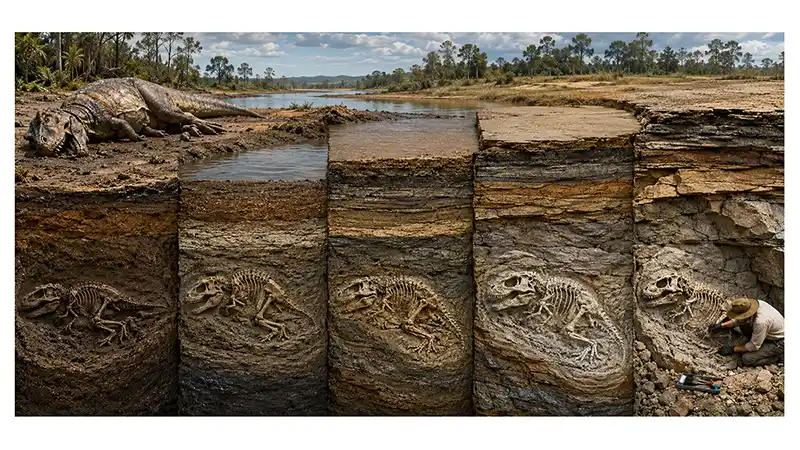
Fossils are the preserved traces of plants and animals that roamed the Earth ages ago as clues to their past existence. You can typically find these ancient remnants embedded within layers of sedimentary rocks, which are formed when mineral particles settle from air, ice, or water.
Body fossil:
A fossil in which all or part of an organism's body is preserved. Soft tissue is usually not preserved, and body fossils usually preserve the skeleton (internal or external).
Trace fossil:
fossil evidence of the behavioral activity of an organism. Examples: caves, footprints, dwellings.
What Does Paleontology Study?
Paleontologists explore and investigate Earth's past, including the fossilized remains of plants and animals. These fossils are essential pieces of the puzzle, shedding light on the development and conditions of various life forms.
These scientists need to know and understand the environment these organisms once lived in, so they study fossils and their associated sediments and rocks. As part of their research, they travel to various places such as museums, universities, and government offices.
Undoubtedly, such excavations are significant to their profession. After successful completion, they spend an incredible amount of time on research expeditions to identify and diagnose fossils. Later, in the laboratory, the samples are studied, and their results are recorded, thus significantly expanding the existing evidence of biological evolution.
Tools used in Paleontology:
Paleontologists use various analytical tools and techniques to examine and extract the fossils they find. In the field, they use excavation tools such as chisels, hammers, precision brushes, and sieves to carefully remove fossilized remains from sedimentary rock deposits.
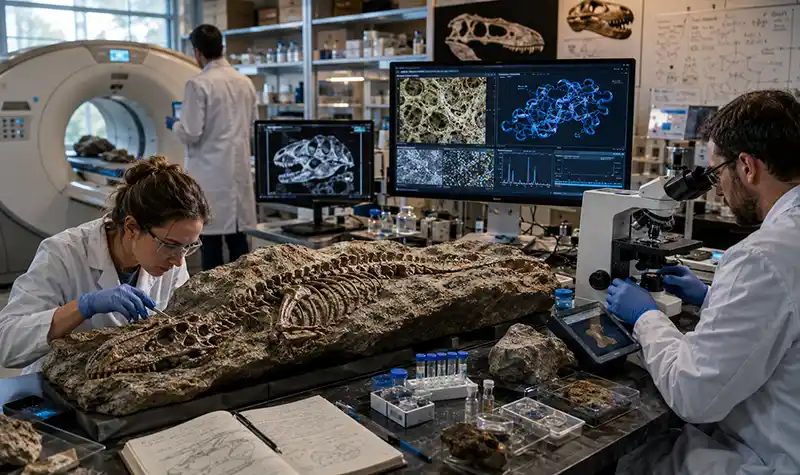
In the lab, they use analytical tools such as microscopes to examine microscopic structures, 3D scanners, imaging software to create digital models of fossils, and chemical analysis equipment such as spectrometers to analyze fossilized tissues.
Why Paleontology Matters Today:
When most people hear the word paleontology, the first thing that comes to mind is dinosaurs. While dinosaurs are certainly fascinating, paleontology is about much more than giant prehistoric creatures. Every fossil—whether it's a tiny shell, a leaf, or a massive dinosaur skeleton—helps scientists piece together Earth's incredible history.
Think of fossils as pages from a book that's billions of years old. Each discovery reveals something new about how life evolved, how continents changed, how climates shifted, and why some species survived while others disappeared forever.
This knowledge isn't just about the past. By understanding how ancient ecosystems responded to dramatic environmental changes, scientists can better predict how modern ecosystems may react to today's climate change. That's one reason paleontology remains an important field of research in the 21st century.
Looking Beyond Bones: Molecular Paleontology
Not every fossil tells its story through bones alone.
In recent years, scientists have begun studying microscopic biological molecules preserved inside certain fossils. This exciting field, known as molecular paleontology, focuses on ancient proteins, pigments, lipids, and other chemical traces that can survive long after an organism has died.
These tiny molecular clues can reveal surprising details, including an animal's diet, body chemistry, evolutionary relationships, and sometimes even aspects of its original coloration.
Recovering complete DNA from very ancient fossils is extremely rare, but preserved proteins have already helped scientists better understand several extinct species. As analytical techniques continue to improve, molecular paleontology is expected to become one of the fastest-growing areas of paleontological research.
What Can Fossils Tell Us About Climate Change?
Earth's climate has never remained the same forever.
Over millions of years, our planet has experienced ice ages, tropical greenhouse climates, rising and falling sea levels, and several mass extinction events. Fortunately, fossils preserve evidence of these dramatic environmental changes.
By studying fossil plants, marine organisms, pollen, and microscopic fossils, scientists can reconstruct what ancient climates were like and how different organisms responded to changing conditions.
Some species adapted successfully. Others migrated to new habitats, while many eventually became extinct.
These long-term records provide valuable insights for today's climate scientists. Although modern climate change has unique causes and occurs much more rapidly than many ancient events, the fossil record helps researchers understand how ecosystems respond when environmental conditions change.
Practical Applications of Paleontology:
Many people think paleontology only belongs in museums, but its discoveries have practical uses in several important fields.
For example, petroleum geologists often rely on tiny fossils called microfossils to determine the age of sedimentary rock layers during oil and natural gas exploration. Fossils also help geologists interpret ancient environments, making them valuable in groundwater studies, mineral exploration, and regional geological mapping.
Beyond industry, paleontology contributes to conservation biology by helping scientists understand past extinction events and long-term biodiversity changes. Museums, universities, and educational institutions also use fossil discoveries to inspire curiosity and improve science education around the world.
In other words, paleontology doesn't just help us understand the past—it also supports research and decision-making in the present.
Common Misconceptions About Paleontology:
Movies and television have made paleontology incredibly popular, but they've also created a few misconceptions.
One of the biggest myths is that paleontologists spend all their time searching for dinosaurs. In reality, dinosaurs represent only a small part of the field. Paleontologists also study fossil plants, marine animals, insects, microorganisms, pollen, and even ancient footprints.
Another common misconception is that fossils are only bones. In fact, fossils can include shells, leaves, feathers, eggs, footprints, burrows, fossilized tree resin (amber), and even fossilized animal droppings known as coprolites.
People also assume every fossil is millions of years old. While many are, fossilization is an ongoing natural process, and under the right conditions, relatively younger fossils can also form.
Understanding these misconceptions helps paint a much clearer picture of what paleontology is really about.
The Future of Paleontology:
The future of paleontology is incredibly exciting.
Every year, scientists discover hundreds of new fossil species, many of which challenge long-standing ideas about evolution and Earth's history. At the same time, advances in artificial intelligence, digital imaging, molecular analysis, and 3D reconstruction are making fossil research faster and more precise than ever before.
Researchers are also exploring previously inaccessible regions, from remote deserts to polar landscapes, where new discoveries continue to reshape our understanding of ancient life.
Although we've learned a great deal about Earth's past, countless fossils are still waiting to be found. Each discovery has the potential to answer old questions—or raise entirely new ones.
That's what makes paleontology such a fascinating science: the story of life on Earth is still being written.
Paleontology is the scientific study of ancient life through fossils, including plants, animals, and microorganisms that lived millions of years ago.
Paleontologists study fossils to understand the evolution of life, extinct species, ancient ecosystems, and Earth's geological history.
Yes. Paleontology is closely related to geology because fossils are preserved in rocks, but it also incorporates principles of biology to study ancient organisms.
Fossils provide evidence of past life, helping scientists reconstruct ancient environments, trace evolution, and understand Earth's history.
Paleontology studies fossils and prehistoric life, while archaeology focuses on human history through artifacts, structures, and cultural remains.
Final Thoughts
Paleontology gives us a rare opportunity to explore a world that disappeared millions of years before humans existed. Through fossils, scientists can trace the evolution of life, understand ancient ecosystems, and uncover the events that shaped the planet we live on today. Every fossil discovery—whether it's a microscopic organism or a massive dinosaur skeleton—adds another piece to Earth's long and fascinating history.
As research methods continue to improve, paleontology is revealing new insights that were once thought impossible. Advanced technologies, combined with ongoing fossil discoveries, are helping scientists answer important questions about evolution, biodiversity, mass extinctions, and past climate change. While much has already been learned, countless fossils remain buried beneath Earth's surface, waiting to rewrite what we know about the history of life.
Whether you're beginning your journey into paleontology or expanding your knowledge of Earth science, this field offers endless opportunities for discovery. The story of life on Earth is still unfolding, and paleontology remains one of the most powerful sciences for uncovering its hidden chapters.